


“I think what we dislike the most is uncertainty… our brains are just constantly trying to predict and constantly trying to find patterns.”
Charities rely on numbers to communicate impact. Yet year after year, supporters nod politely when you quote your statistics – without really understanding or feeling the profound meaning behind them.
How can you translate your numbers so donors connect emotionally and feel moved to give?
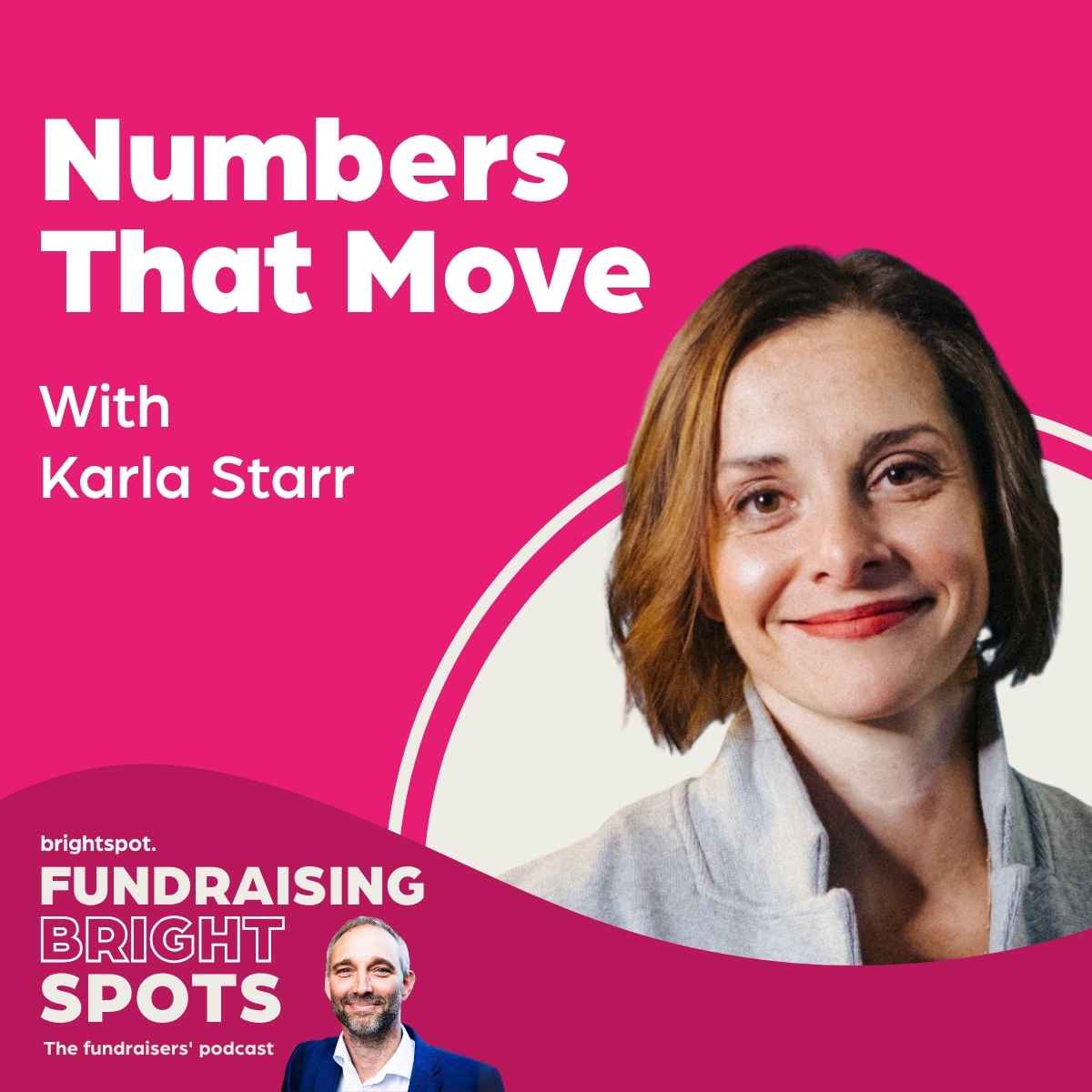
Rob was thrilled to talk to Karla Starr, co-author of the brilliant Making Numbers Count, to share
techniques for bringing your most important numbers to life.
Whether you’re writing grant proposals, donor reports, campaign appeals, or you sometimes pitch for funding, this episode gives ideas and examples to help you make your numbers sing.
—
Timestamps
Here’s a more condensed set of chapters, in UK English:
Introduction (00.00.00)
Rob sets up the episode’s theme: how to make numbers in a funding application, pitch or conversation land more persuasively, and introduces guest Karla Starr, co-author of Making Numbers Count.
Karla’s background and how the book came about (00.02.08)
Karla studied psychology and behavioural science and had always wanted to be a writer. Her first book caught the attention of Chip Heath (co-author of Made to Stick), who invited her to collaborate. The idea for Making Numbers Count grew out of a Stanford student’s challenge: “you say don’t use numbers, but my whole world is numbers.”
Why numbers don’t stick on their own (00.05.01)
They discuss “subitising” — our brain’s ability to instantly recognise small quantities (up to about five) without counting — and why larger, precise figures like 11,367,285 overwhelm short-term memory. Karla explains the “illusion of objectivity”: precise numbers feel authoritative, but that precision often comes at the cost of the listener actually understanding what’s being said.
Attempting a translation, even an imperfect one (00.10.11)
Even bright MBA students struggled to bring stats to life until given simple principles. Karla’s example: instead of citing Spider-Man’s box office in dollars, one article compared ticket sales to “the entire population of Texas” seeing the film in a weekend — proving you don’t have to sacrifice clarity for precision.
Tuning translations to your specific audience (00.12.23)
A Texas comparison works for American listeners but means less to UK or Bahamian ones. A fundraiser reframed “200,000 people a year” as “as many people as attend Glastonbury every year” — concrete and tailored to an arts-sector audience.
Giving yourself permission to round (00.14.46)
Karla argues for rounding confidently — “roughly two thirds” over “64.5%” — since the goal is painting a clear picture, not lab-grade precision. Rob shares two real examples: a domestic violence charity swapping “80%” for “four out of five women,” and a special needs charity in Australia using a school bus full of children to represent a percentage visually.
Overcoming the curse of knowledge and “bigism” (00.18.52)
They discuss how experts overestimate what others already understand, and the trap of reaching for the biggest, most abstract number available. A fundraiser replaced “11,000 referrals per year” with “we help nine children every day” in a corporate partnership pitch — and won £25,000.
Find Your Fathom (00.21.06)
The book’s central technique: finding a concrete, relatable “unit of measurement” for your audience. Examples include stairs worth $100,000 a step to illustrate Elon Musk’s wealth, comparing female CEOs to CEOs named John, and a theatre’s seating to illustrate the scale of children reached by an arts charity.
Where the name “fathom” comes from (00.26.56)
Karla explains the nautical origin of a fathom (arm span, later six feet of water depth) as the inspiration for the phrase, and shares the “deck of cards” example for meat serving sizes — a more universal, less variable measuring stick than “roughly the size of your hand.”
—
Further Resources
Fundraising Bright Spots – Small shifts, big results with Sarah Pryer
Stay in touch
To join our mailing list / get access to our newsletter, including to hear about our popular Breakfast Club for Fundraising Leaders, which happens every 3 months, follow this link.
Inspire your team with Bright Spot Training.
If you find these podcasts, Rob’s Breakfast Clubs or blogs helpful, imagine the difference it would make if your whole team spent a day learning Bright Spot fundraising techniques. We’re immensely proud of the way these bespoke team training days boost your team’s skill, mojo and results. To find out more, or request a chat to think it through, here’s the link: Team Training.
Want to transform your Corporate Partnerships or Major Donor fundraising?
To learn tried and tested techniques for growing corporate partnerships income, and get help in implementing them, check out our ever popular Corporate Partnerships Mastery Programme.
Or to grow your skills, confidence and results in Major Donor or Trusts fundraising, check out our flagship Major Gifts Mastery Programme, now in its eleventh year.