


Episode Notes
Many trusts and foundations receive hundreds of applications for funding from charities. Usually only a handful are successful. So what can you do to defy the vicious odds?
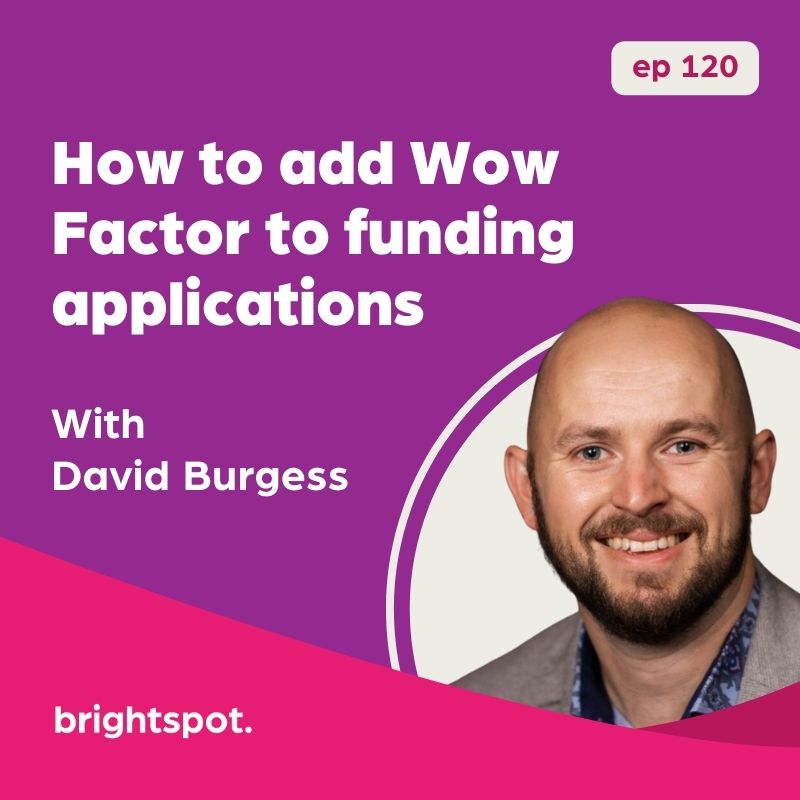
This time, Rob talks to David Burgess, who shares what he has learned from time on the other side of the fence, for instance when he has had to choose a few proposals out of 250. He argues that if your form blends in with the rest, it is almost impossible to make the cut.
David and Rob discuss lessons we can learn from one creative fundraiser who has found effective ways to make his applications STAND OUT. In so doing, his success rate rocketed up from 1 in 6; to 1 success in every 2 or 3 cold attempts!
If you want to share this episode with others you think it would help, THANK YOU SO MUCH! We would love to hear what you think. David and Rob are both on Linked In and on twitter Rob is @woods_rob and David is @DavidBurgessFR; or you can follow Bright Spot on Instagram at @brightspotfundraising.
Further Resources
To get a snapshot of what the first page of Matt’s innovative proposal looked like, click here.
Episode 32 How to grow income through trusts and foundations, with Andy Watts
To join our mailing list / get access to our newsletter, including to hear about our popular Breakfast Club for Fundraising Leaders, which happens every 3 months, follow this link.
Want to go deeper and get 24/7 access to LOTS more inspiring training?
Our training and inspiration club for fundraisers, the Bright Spot Members Club, has an extensive library of Rob’s best training films, a supportive community, and access to live masterclasses and problem-solving sessions with Rob and other experienced fundraising / leadership trainers EVERY WEEK. To find out more about how to get access to all these resources, go to www.brightspotmembersclub.co.uk/join/
Would you like training, inspiration and support to increase high value fundraising income?
You can find out more about our flagship six month programmes: the Major Gifts Mastery Programme or the Corporate Partnerships Mastery Programme by following these links.
Quote
‘It doesn’t matter how good your fundraising copy is if no one’s reading it…so how can I present the information in a way that stands out?’
David Burgess
‘The starting point was, I don’t want my proposal to look the same as the 199 other proposals in that pile. So what am I going to do that’s different?’
David Burgess
Transcript of Episode 120
Rob:
Hey there folks, and welcome back to the Fundraising Bright Spots Podcast. This is Episode 120. My name’s Rob Woods and this is the show for anyone who works in fundraising who wants ideas and maybe a dose of inspiration to help you raise more money and really enjoy your job.
Now, if you’re interested in ways to increase your success rate when you apply to trust and foundations, I hope you’re going to find today’s show really helpful because I’m pleased to be able to share a conversation I had recently with a smart and experienced fundraiser named David Burgess from Apollo Fundraising. As a consultant and trainer, David has long specialized in helping arts and culture organizations of all shapes and sizes to achieve their fundraising goals.
He’s also chair of the Chartered Institute of Fundraiser’s Cultural Sector Network and curates the fundraising Everywhere conference on trusts and major donors. One great advantage that David has when writing applications is that he has experience on the other side of the fence as the person making decisions about which applications out of hundreds will be successful. This perspective has given him valuable insights that I believe could be helpful for any of us who want to increase the chances that our proposal or application will be successful and to bring these ideas to life. David describes a technique that one fundraiser has found brings dramatically better results compared to the orthodox approach that most charities use. Hi, David, how are you?
David:
I’m very well, thank you. How are you?
Rob:
Yes, very well. Thank you very much and thank you for making time to chat to us for the podcast. So David, you’re a very experienced fundraiser. You’ve done lots of fundraising and in particular some of the things you do are focused on case for support and strategy and trust fundraising for instance, among other things. And in today’s show, I want you to focus in on things to do with the application writing process because I think you’ve discovered that just are some things that many charities can improve on with relatively little effort. I wanted to start in terms of hearing a perspective you’ve had from when you are on the other side of the fence.
David:
Yeah, absolutely. So as you said, I spend a lot of time writing proposals and I’ve always been really interested in what happens once you click submit or you send it off in the post because often that’s the last week here until we get that response from a funder. So I’ve been quite lucky over the last couple of years we’ve been in a position to set up small funding rounds just to see what it’s like on the other side, but also to give back to charities In terms of the number of applications, the last one we ran, we had over 250 applications from charities of all shapes and sizes. We kept the funding criteria quite broad. We were making grants to help charities be the best they could be and we wanted to keep it unrestricted. We wanted to hear from charities where they needed that funding and to give them the chance of applying for that and seeing what it feels like to write an application in that way.
To put that in context, that’s about average for small to mid-size grant funder. They’re getting between 200 and 300 applications per funding round and then trying to whittle that down to maybe 30 that go to the board of trustees for that final decision. And that’s a really fascinating process to sit there and try and compare those. And I think one of the things that quite quickly I noticed doing that is just how many look and sound and feel the same and how quickly you stop being able to tell which charity it is because they all sort of blur into one. And I have a newfound respect for grant managers because that process of reading proposals is exhausting. It is so mentally draining to have to keep focused and very quickly certainly. I found this very quickly, you can start just sort of going through the motions of reading it to get through because it’s very difficult to see that split between them because they will start looking the same, sounding the same. Oh good, yes. Another proposal that looks and sounds and feels like a funding proposal.
Rob:
So that’s quite tough isn’t it, for the person writing the thing because to them, they are just writing sensible things that describe their charity. The problem is designed to solve how many people run it, how effective it is, and they’re not intending to blend in with the other 249, it’s just when you read all 250 in a row, just that is what tends to happen, right?
David:
Absolutely. And I think it’s because we don’t necessarily see that other side. All we see is our proposal and we’ve learned how to write that proposal from other fundraisers, whether that’s our line manager or from training courses, but we’re taught an approach that is how do we get the information on the page and absolutely all of those proposals that we read had the information we were looking for, but it’s then looking at saying, “Well, if I’m in a competition with 199 other charities, not just for the money, but even before we get to that point for someone’s attention and to stick and really make an impact on the person reading it, what can I do to change that narrative? What can I do to make my proposal, my organization, my project stand out?” Because it really is fine margins getting 200 proposals down to 30 and that’s where that human side really kicks in because people start something.
What is the one that I remember most? I remember enjoying reading this, I remember feeling something reading this, and it is a human process and that is the bit I think we lose sight of. It’s not in most cases a machine reviewing that we might get to that point further down the line at the moment, this is really like any other form of fundraising. We’re trying to compel and inspire and excite and engage a real life human being on the other side of this. Yes. So I think looking at where we can stand out from the crowd, what can we do to make our project leap off the page and really engage the reader in what we’re trying to do?
Rob:
And what really stands out to me and what you’ve just said is I think the question, how can we stand out? How can we leap off the page? How can we get their attention? I think that is a different question to what many of us might consciously or unconsciously be answering when we fill in the form. We might be more answering the question, what information do they need? What information have they asked for? And that’s not the same as how do I get their attention?
David:
That’s it. Yeah, as you say, it doesn’t matter how good your fundraising copy is if no one’s reading it. I think that’s the skill in this, isn’t it? It’s being able to do both saying if this is what they want to hear or this is what they need to hear to make that judgment, how can I present that in a way that stands out? How can I present that in a way that brings that information to life so it isn’t just a feeling like quite a cold description of our organization and a very academic expression of what the need for our work is and a description of our project that is factually accurate but makes sense in your head but doesn’t really appeal to the heart of the person that’s reading that.
And that’s why I think there’ve been some really nice examples from reviewing that, that have been able to do that really well. And interestingly, the one I want to share in a second started from the point of view of saying how can I make this stand out? A by-product of that is they actually then were able to bring that information to life as a result of doing that. But the starting point for that was I don’t want my proposal to look the same as the 199 other proposals in that pile. So what am I going to do that’s different?
Rob:
And I remember you first mentioned this example at one of the… I Wish I’d Thought Of That (IWITOT) events, which I love going to, I always get some great ideas and examples and inspiration for fundraising things people have done at the… If we’re taught event, and I think it was four or five months ago you shared this example. So for our listeners, could you just tell that story of one of these applications that you received?
David:
Absolutely. So this is a proposal that was written by Matt Sachiri, who’s a fantastic trust fundraiser. And at the time he was working for Chapter, which is a mental health charity in the northwest of England. And I was probably 10 or 12 proposals into reading applications that had been written using the generic Microsoft Word. I see you’re writing a funding proposal template. I opened up Matt’s proposal and all of a sudden I was struck by the fact it looked different. And what Matt’s has done in his proposal is to structure it as a conversation. So the first thing you see is two avatar characters, one with flowing brown hair, a very trendy looking beard to represent Matt in the fundraising role and talking from the perspective of chapter and then a young lady with again, shoulder-length, brown hair glasses, red tank top, which I think is supposed to be me and you framed it as a conversation with the trust representative there asking questions.
So they start by saying, hello, to kick things off, please could you tell us a little bit about your organization? And Matt then writes, certainly chapter provides support to people with severe and enjoying mental illness in Cheshire West and Chester, our tailored program of one-to-ones group activities, training and voluntary work placements help our service users grow in confidence, improve their mental health, make new friends and feel hope for the future. And the proposal carries on as this back and forth with the grant representative asking those questions, but asking what Matt knows the funder needs to know to make that decision. So it starts as a structural thing, but it enables him to work through that process of what information do I need. I’ve spoken to Matt about this a couple of times and Matt comes from a background as a comedy and script writer and came into fundraising through that.
So when he was looking to try and stand out from the crowd and looking to disrupt that approach to writing proposals, that was a natural place for him to start. But as I say, it started with that approach of standing out, but it has a number of other benefits as well. So you can see from his answer and even from the way he poses the questions, he’s writing a very human approach. It’s almost informal because that’s how we have conversations and there is a habit I think when we’re writing proposals to get into quite a cold distance way of writing, we write almost in a sort of academic way as if we were writing it as an essay and Matt completely breaks that down, which enables the reader then to build that sense of connection with him. And we’re talking fundraising all the time about people giving to people.
That feeling that I’m having a conversation with a real life human on the other side of this I think is a really powerful way of drawing someone in and connecting them to the work. He also keeps the answers really short. So that extract I read was the whole answer there to tell us about your organization just enough to get a flavor of what they do without going through, here’s 200 years of our history and taking up four pages just talking about yourself and that’s the case throughout the proposal. The answers are really succinct, just get to the point of what the fund needs to know. And then moving on, one of the things I think with that being quite informal is it’s very easy to read. And again, I talked to the point when you’re faced with that pile of 200 proposals, it is exhausting.
We don’t think about the mental efforts that it requires to read those and to understand proposals. And particularly when we do start writing in quite a cold sort of almost computerized way. And I ran quite a few of the proposals through the Hemingway app, which I’m sure many of your listeners will know, but it’s a really great tool for telling you the reading level of text you’ve written and giving you suggestions for how you can make it easier for people to read. The Hemingway app I think suggests anything below seven is a good score. The proposals we received at the same time as Matt’s, the average for them was over 10. Matt’s proposal scores six. So right under that sweet spot for making it very easy to read because again, grant managers don’t have huge amounts of time for this and you’re having to carve out time in and amongst other jobs and particularly for trustees. So having something you can read and understand quickly is a massive advantage.
Rob:
And on that, what would you say if from our point is the charity or the person writing it? Our point might be, yeah, but we are dealing with really complex difficult issues, so these are sophisticated intelligent ways we solve this thing. We can’t be dumbing down in the way we describe those interventions. Surely and surely there’s a level of intelligence in the person who’s reading the funding proposal
David:
Well, so I think that’s an interesting one, the level of knowledge that the grant manager or a trustee might have in your subjects area because even for quite subject specific or sector specific funders, actually even within that, the range of organizations, the range of projects they’re going to be supporting is quite broad and it’s say it’s almost impossible for any one person to have that in-depth understanding of all of those different needs that you might be addressing on all those different ways of working. Particularly true when we move away from the grant manager into the trustees, which can often come from a really broad background. So let’s say for example it was a science and medical research funded that you were applying to, there are almost certainly going to be scientists on the board, but they’re going to be covering a really broad range of interest and specialties.
So I think we overplay that insight knowledge that our readers are going to have. So I think there’s a couple of things, but it is spelling it out so someone can get a picture of it and it might feel dumbing down for someone that knows that organization very well. I think there are very few cases where that’s going to be the case on the other side or you can present it in a sort of two stage way. And that’s something Matt does quite nicely actually in this.
So in that introduction, can you tell us a little more about your organization? That first line chapter provides support to people with severe and enduring mental illness. You might say that starts being a little bit jargony, which is why the next question in the proposal is when you say severe and enduring, what does that mean? And it gives them a chance to dig into that and say, “Okay, if you understand that, great. But as it says NHS based term, which refers to any diagnosis with very live limiting symptoms and which lasts a long time.” So you can pick out if you think something’s going to need a bit more exploration. Is this a good time to talk curse of knowledge?
Rob:
Yeah, I think so because in my experience we think that it is possible to come up with many reasons why speaking more clearly, more plainly can appear to be dumbing down. It can appear to be simplistic, but I think lots of the reasons we might initially believe that to be true are broadly because we have so much knowledge if we’ve worked for a charity for more than a month, and it’s hard to necessarily tell what you now have absorbed as normal and natural ways of describing a particular cause or service that before you worked there you just didn’t know that and you didn’t certainly didn’t know those phrases for describing that.
So over to you David, we’ve both discovered this term, I think I first discovered it in a book called Made to Stick, which I highly recommend by Chip and Dan Heath and they talk about the curse of knowledge as causing lots of challenges for companies or charities that are seeking to be properly understood. What’s your take on it and the reasons it can really be so powerful in getting the way when we are writing these applications?
David:
Yes, I think I first came across it in Made To Stick as well, and they talk about it as once we know something, we find it very hard to imagine what it was like not to know that. And that’s what they mean when they talk about our knowledge cursing us. And I think probably an example that I’m sure I know you’ve talked about it in training sessions and I’m sure many of your listeners will know is the clapping experiments that Elizabeth Newton ran I think in the seventies at Stanford University, and I think she was the first one to really start looking at this. But in that experiment dividing the room up, getting one person to clap a well known tune or nursery rhyme and trying to get the other person to identify it and watching as the clapper gets very frustrated thinking, how on earth can you not get this?
This is so easy, it’s the national anthem or it’s Jingle Bells or whatever it might be. And I think the reason it gets frustrating for the clapper is because they can hear the whole song in their head, so they’re clapping on, but they can hear the melody line, the person listens that doesn’t have that context, they don’t have anything to hang that rhythm on. So it just sounds like it’s like a three-legged horse tap dancing. We can’t make sense of it. And that’s what happens when we write. And as you say, if you’ve been in an organization even for a month, you have engaged all of your senses and understanding what your organization does. So when you’re trying to put that on the page, you’ve got all of that going on in your heads and when you start to describe that work, it makes sense to you because you have that skeleton in which you’re hanging those pieces. The reader obviously doesn’t have that.
Rob:
That makes sense, David, and have you found, or has Matt found that this approach, granted it makes good sense in the ways you’ve been explaining, but I guess the critical question is it effective or indeed is it more effective than if we take a more orthodox approach to writing?
David:
Yeah, so for Matt’s proposal in the funding round we were looking at, it was the top scores proposal by all of the trustees and received the largest grant we awarded in that funding rounds. But I spoke to Matt to ask him what success he’d seen and he was quick to say that it wasn’t something he could do with every funder and he knew he had to be selective about when this approach would work and when he needed to do something a bit different where he took perhaps a more standard approach, he was seeing at a success rate of about one in six, which is probably about average for code applications and perhaps slightly better than the average there. But when he was able to use this approach, the conversational format and that standout approach, he was getting success rates of one in two to one in three. So a massive change then just by being able to stand out from the crowd and present the information in that way.
Rob:
Hi, it’s Rob and I wanted to jump in quickly to let you know about our two flagship courses designed to help you grow high value fundraising results. That’s the Major Gifts Mastery Program and the Corporate Mastery Program, which are starting again from mid-May 2023. Rather than have me tell you about how they work, I thought it would be most interesting if you could hear from someone who’s done one of these courses recently. So here is a short clip from Sam Harford who is a philanthropy officer at the British Red Cross talking about her experience.
Sam
If you want to improve your major donor approaches and raise more money for your charity, I would really, really recommend Rob’s major donor mastery course. It was absolutely fantastic for me and built my confidence so much and I really began to change my mindset and start focusing on cultivating for major donor relationships rather than major donor gifts. Since joining the program, I’ve raised over £600,000 in pledges and donations, so I’m really grateful for all of the support and guidance from Rob.
Rob:
If you’d like to find out more, go to bright spot fundraising.co.uk/services. Right now, let’s get back to my chat with David about ways to increase your success rate when applying to trusts and foundations. Maybe one reason you think it’s so effective for Matt’s organization is that taking this creative approach of the conversation on the page is consistent with what the charity is all about.
David:
Yeah, absolutely. And Matt addresses that with the final question and it’s a really and nice approach is the final question posed by the grant funder in this made up conversation is isn’t this a format just a gimmicky way of making you stand out? And Matt’s answer is, of course, we hope it makes us stand out, but talking is very important to chapter one-to-one communication is the backbone of our support. So we thought there was no better way to showcase our work than by having a chat. Thanks very much for listening to us. So as you say, a really nice way of bringing their values, bringing their work to life in that unexpected way, it leaves you with a smile on your face, which is one of the things I really love about that, partly because of the tongue in cheek setup of the question, but that really clever way of wrapping it together, bring it all back and saying, this is who we are, this is what we do. You just can’t help but sort of sit there and say that’s that’s good. I like that.
Rob:
Yeah, and there’s a couple of things that spring to mind for me about that. One of them is just in terms of objection handling. If you as a charity from conversations with funders know that very often there’s one or two things that often come up as to their rationale for why they can’t fund you. Be it because you’re too big or too small or you are national or you are not national enough, whatever it might be.
A really good tactic in conversation and indeed on paper often is to quite deliberately bring up the objection and reframe it and put your point of view as to why actually what appears to be an objection is the very reason why we should be funded by you. So that’s one smart thing I think he’s done there. And the other one is on the programs I teach when I’m teaching fundraisers how to create wow moments, special different moments of delight or surprise compared to what the funder might be expecting be they a corporate partner you are pitching to or a major donor you are talking to, there’s a power to doing things differently as I think Matt has done beautifully here.
And one of the important things I teach there is that some of your initial creative ideas just might be too far. It should stay on the flip chart. Please don’t take this really wacky approach to pitching or writing or a demonstration in a meeting with a donor and actually do it to them. It’s just too much. You can kind of tell why it wouldn’t work. You might have a kernel of a reason why you were doing it, but you’d lose so much rapport with them as they were trying to work out what on earth you were doing or why you did that. So I don’t teach that we should take crazy risks. I do teach, we should really think carefully and deliberately about ways to stand out and the ways Matt has used are not clearly going to suit all applications or all causes. So that’s not the message of this interview. But do think how an earth can I help it visually come off the page so that people notice it compared to the other 95%.
And that might be as simple as really kind of better design, visually making the quotes stand out, different use of fonts and highlighting and images if that is possible and appropriate. So there are ways to make it stand out, albeit a more conventional way of telling the story. But the point I was going to make is if you are thinking carefully, how could I create more of a wow moment that leaps out at them? The way to make sure it’s not a gimmick is to ask yourself if after they saw this or read this or heard this in my pitch, would they understand why I chose to do it that way? Does it make sense? And I think Matt has done that beautifully. Of course, it’s a conversation because that’s what you are all about. And I just remember, I mean I’ve got lots of examples of this, but one of my favorites was a brilliant fundraiser who was applying to get into running for the charity of the year process for a wine company and she printed out the form and she filled it all in as was the orthodox thing to do.
But then she solved this, how do I stand out challenge by rolling it up and putting it in a wine bottle and taking it round to the reception of that company be, why did she do that? Because they’re a wine company in a bottle after it’s, I mean you could take such a risk and it’s still not work. And they say, why are charities wasting this time doing these strange things? Of course there’s always some risk when you choose to wow someone. But the long story short, they were invited to pitch and they walked into the room already with some credit in the bank and they pitched beautifully and they won the charity of the year. So the point I’m making is there are some creative approaches which really are too big a risk because they’re a gimmick. It doesn’t quite make sense either for this funder or for your charity, but I think a far bigger risk is for us to not to put energy at all into finding some way that our pitch or proposal in some way get their attention and stand up.
David:
Yeah, absolutely. And if Matt’s proposal in following that conversational format or whichever way he tried to make it stand out, didn’t give the funders the information they needed to make that assessment, or if it watered it down that actually made it harder to read, albeit signing out off the page, then you’re absolutely right. And I could often talk about the curse of clever. So we’ve had the curse of knowledge with the curse of clever where in a desperate attempt to try and either make a pun work or bring in a structural element, you actually lose sight of what that document or what that message is ultimately there to do. So yeah, the form has to follow the function. If the function is to get that information across, make sure that they’re not competing and they’re not having to make compromises on in that front.
Rob:
Say differently. A good tip for people to is to think what are the one or two most important ideas or messages that would cause this funder or this company to say yes to put us through to the next round? What are those one or two concepts? Let that be the starting point for where you try to get creative so that you bring so through your different approach, your different font, your different photo, your different audio treatment, your different visual, whatever your different means of sending it through to them because it comes via a film new attached with as a link. Let the creative thing be a way of bringing out one or two of those key points and then probably it will be justified. Yeah, but often it goes wrong is where we’ve got some clever idea that doesn’t reinforce a concept that deserves more attention.
David:
I think. Yeah, you’re absolutely right. And in terms of what they want to get across, again, Matt uses that to structure the questions so he knows the ultimate thing the funder is asking is why should we fund this? Why is this right for us? So he asked that question, why have you chosen to ask us in particular? Not why should we fund you or what do you need funding for? Why have you asked us? What do you know about? And it gives him that chance to link it all back to saying, we know this is what you’re interested in. This is how we tie that conversation together.
Rob:
I think one other thing I remember from your presentation, I know it seems obviously in a way maybe our listener will think of course one would do that, but I think you mentioned he brings the key points alive through various voices, not primarily his own. You just mentioned that again.
David:
Yeah, absolutely. So there are some things in there that I think Matt knows aren’t right coming from him. There are better people to tell that story. So one of the questions is can you tell us more about the group activities? And Matt can give a sort of broad oversight of what they do, but to get that real in-depth understanding of why that matters, Matt brings in, he said, “Here’s Joe to tell us about that.” And he does. It’s written as a sort of mini case study. It’s about three or four sentences long of Joe saying, “I’m Joe, I have suicidal thoughts every day. I’ve been with Chapter for a few years now. I mostly get involved in the allotment project, being able to make plans for the allotments, he’ll be there, how the weather will affect it gives me structure and something to make plans for without chapter, I don’t think I’d be here today.”
That’s obviously not something really Matt can say or is not as powerful coming from Matt. So bringing those voices, other voices in gives it that authenticity. It also breaks up just in case that conversational format starts getting a bit sort of monotonous, whether it’s just those two voices bringing in that variety helps as well keep people’s attention.
Rob:
So that’s that concept of show them don’t tell them. So that they can see that it’s warm. Feel that it’s warm rather than you telling them that it’s warm. David, when we were planning this, we were both clear, we are not… I mean sometimes there just is a format, a certain form you’ve got to fill in anyway, so clearly this tactic won’t work then. But equally, I don’t think we were saying this avatar conversation narrative could or should work every time, but just before we finish, what are you saying via this little example that many of us could do our best to work hard at when we fill in applications.
David:
So I think Spencer, I think what are those key points you want to get across and think how can I bring that to life? How can I get that to leap off the page so that the person reading it a takes notice of it and then it’s done in a memorable way? I think if that means changing the format in some way to help bring that look at opportunities and have a play around with it, even if they’re not on sort of live proposals, I think what are some of the tools or the devices we’re using in our work? What does our work look like on a day-to-day basis? Is there a format or is there a nugget of an idea there that we can delve into? I think looking at how you use story and particularly how you bring that passion and that emotion into it.
Again, whether that’s bringing in other voices throughout the proposal, again, even with a standardized template, there’s space there for case studies or quotes or someone else’s words that have credibility and that can bring that to life. And I also wonder, I think it’s about giving the read of the reason to read on. So ask questions again, draw me in by setting me a challenge. So asking me something I don’t know the answer to and want to find the answer to subvert what you think I know about your organization or your work or your area. Tell me something that’s going to surprise me or disrupt something that’s going to snap me out of just going through that process of thinking, right? I’ve got to get from the top to bottom and move on. Because if we can draw someone, if we can really reengage them again, it’s going to make it more memorable. There’s more chance that it’s getting that message across.
Rob:
Yeah, I really like that point and it really stood out to me in Made To Stick by Chip and Dan Heath, the second of their six points they make for what kind of information is most likely to influence and persuade. It’s unexpected or not obvious and there are always things that are not immediately obvious either about the problem that your charity solves and indeed about how you solve it or how effective you are at making things better. So seeking the unexpected or not immediately obvious and giving more airtime or visual time or visual space to those, having those things stand out is a really powerful and very practical tip I think we could all use even if we’re filling in a really orthodox standard form where we have to jump through the hoops. David, we need to finish very soon. Thank you so much for all this excellent advice. If people want to follow up with you separately, I guess they could do that via LinkedIn, but equally tell us about Apollo and where we’d find your company details.
David:
Yeah, so on my website I’ve got a number of free resources and often that includes things I’ve written up after doing these grant funding rounds of various tips that have jumped off the page from doing that. So if you go to apollo fundraising.com and there’s a blog section there that’s got articles and you can search for trust and foundations. I think there’s four or five. There’s something about the curse of knowledge. I have various tips on there and I’m also on Twitter as well at David Burgess. Again, I share a range of things. There’s mostly fundraising. But yeah, those are probably the two best places to find me.
Rob:
Fantastic. So David, thank you ever so much for making time to share these examples and these tips. I really appreciate it. I know our listeners are going to find it helpful too and I look forward to catching up with you very soon. Bye-bye.
David:
Pleasure. Thanks very much Rob, lovely to see you.
Rob:
Well, I hope you found our discussion helpful. You can find a full transcript of the episode as well as an image showing the first page of Matt’s avatar conversation style application in the podcast section of our website, which is brightspotfundraising.co.uk. If you’ve not yet subscribed to the fundraising Bright Spots Show, please do that now so that you don’t miss out on any of the episodes we’ve got coming up. This will also get you immediate access to lots more episodes, including, for instance, the very popular one we made with the brilliant Andy Watts about techniques he used to grow income for his hospice charity through trust and foundations by 349%. That is episode 32 of the show. If you are a corporate or a major donor fundraiser and you’re determined to lift your results this year, we are now accepting bookings for our next Corporate Mastery Program and the Major Gifts to Mastery Program, which start again in May, 2023.
To find out more about the difference these programs make, do check out the information on our website @brightspotfundraising.co.uk/services. If you found today’s episode helpful, then I’d really appreciate it if you could take a moment to share it on with your colleagues or on social media so that we can spread the word and help as many people as possible. Thank you very much for your help and we’d love to hear what you think you can get in touch or tag us both on LinkedIn and on Twitter. David is @DavidBurgessFR and I am @woods_rob. Finally, thank you so much for listening today. Best of luck with your funding applications and I look forward to sharing more bright spot stories with you very soon.