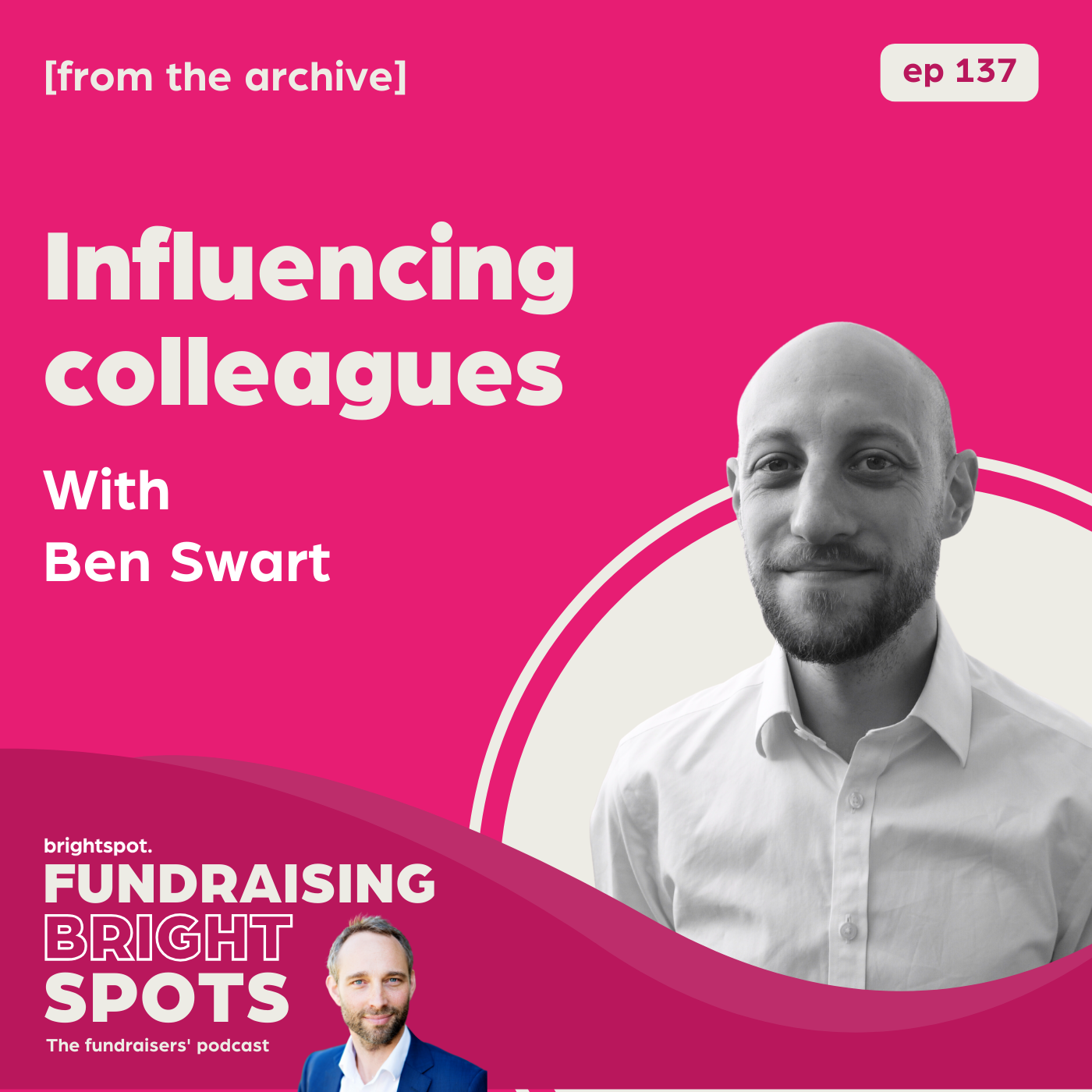


“The times when I’ve managed to have a calm conversation with the other person to solve the difficult issues, is when I have a hundred percent assumed that it’s something that I could have done differently.”
One of the most difficult challenges for many fundraisers is encouraging colleagues to see things from the supporter or partners’ point of view, and to want to do things that would deepen relationships with those supporters and help grow income.
And in corporate partnerships fundraising, excellent partnerships are never possible if they’re solely driven by the fundraisers’ hard work. They can only happen if they are genuinely a partnership between two organisations.
But with many competing priorities in a charity, it’s not always easy to get colleagues to understand / want to do things that would serve the partnership or fundraising project. They’re very busy handling other issues.
In this episode, Rob Woods talks to corporate partnerships expert and Bright Spot trainer, Ben Swart. They talk about practical things you can do to find common ground and positive outcomes with other teams in your charity.
If you want to share this episode because you think it will help other charities – THANK YOU! – We are both on LinkedIn and on Twitter, where Ben is @benswart and I am @woods_rob.
Episode overview
[00:50] Ben and Rob discuss the challenges that fundraisers face when trying to get support from colleagues within a charity.
[04:05] Ben shares the importance of collaboration and the need for fundraisers to work together with colleagues from different teams and departments within the organisation.
[07:56] Ben uses the story of Tanya Steele’s experience – realising the different objectives and motivations of teams within a charity and the need to understand and find common ground with them, especially when there does not appear to be any.
[10:56] Rob and Ben talk about one particular fundraiser’s story and their frustration with their digital team’s resistance to promoting a major corporate partnership on social media. As well as how they discovered the reasons behind it through a conversation with the Head of Digital.
[13:48] Ben explains the importance of storytelling in engaging followers on social media, along with the need for fundraisers to understand the perspective and challenges of different internal teams.
[20:15] Rob and Ben explore the importance of remaining calm and seeking to understand the other person’s perspective in order to have productive conversations. And emphasise the need to not only understand but also emotionally appreciate the challenges and pressures the other person may be facing.
[28:23] Ben gives an example of how applying these principles helped improve the negotiation with the social media team, leading to the co-authoring of engaging content and increased engagement.
[32:52] Ben shares the positive outcome of collaborating with one of the commercial team’s biggest clients, resulting in five times more engagement than previous efforts.
Further Resources
Strategic Corporate Partnerships with Ben Swart (Fundraising Bright Spots Episode 38)
How to use contrast and storytelling to inspire with Ben Swart (Fundraising Bright Spots Episode 90)
Stay in touch
To join our mailing list / get access to our newsletter, including to hear about our popular Breakfast Club for Fundraising Leaders, which happens every 3 months, follow this link.
Want to transform your Corporate Partnerships or Major Donor fundraising?
To learn tried and tested techniques for growing corporate partnerships income, and get help in implementing them, check out our ever popular Corporate Partnerships Mastery Programme.
Or to grow your skills, confidence and RESULTS in Major Donor or Trusts fundraising, check out our flagship Major Gifts Mastery Programme, now in its tenth year.
Want to go deeper and get 24/7 access to LOTS more inspiring training?
Our training and inspiration club for fundraisers, the Bright Spot Members Club, has an extensive library of Rob’s best training films, a supportive community, and access to live masterclasses and problem-solving sessions with Rob and other experienced fundraising / leadership trainers EVERY WEEK. To find out more about how to get access to all these resources, go to www.brightspotmembersclub.co.uk/join/
———-
Transcript of Episode 137
Ben Swart (00:00:01) – And then somebody else actually said, and you know what, I’m in the middle of a staff vote campaign at the moment, you know, like a charity of the year thing. And all I want to do is to get us jumping up and down, being as excited as I am that we should be winning this partnership. It’s not a small partnership, Ben. It’s like a six, seven figure partnership. And yet my digital team, they’re really fighting with us about putting this stuff on Twitter.
Rob Woods (00:00:25) – If at some level you’re already annoyed and you come across as defensive and your tone is why is that? What’s your problem? Already I think they’re less likely to truly open up and in a relaxed way tell you what’s really on their mind and what the real challenges are. In my experience, if you allow it to get to a red hot disagreement, it’s already a bit late.
Ben Swart (00:00:50) – We realise, you know, actually there’s a couple of things that we could do to try and make our lives slightly easier and their lives easier too.
Rob Woods (00:01:00) – Welcome back to the Fundraising Bright Spots podcast. This is episode 137. This is the show for fundraisers, looking for ideas and maybe a dose of inspiration to help you enjoy your job and raise more money. Now one tough challenge for many fundraisers that is unlikely to go away any time soon is what to do when you need help from your colleagues. For instance, in order to improve corporate partnerships, fundraising, or indeed any donor relationships. But your colleagues, well, they just don’t buy into what needs to happen or what you’d like them to do. This internal conflict is often stressful, and it certainly makes growing your fundraising results very difficult. So to help, I’m about to share my discussion with corporate partnerships expert, my colleague Ben Swart, as well as coaching on the Corporate Mastery program. Ben also delivers excellent in-house training days and packages for fundraising teams, as well as more in-depth corporate partnerships consultancy to help charities make an internal step change in their results. As this podcast has grown and grown in the years since we started back in the autumn of 2019.
I’ve realised that for listeners who discovered the show fairly recently, there’s a good chance you’ve never heard the ones we put out in the early days, and I think that’s a shame because a lot of those topics are still as relevant as ever. For context. We recorded this interview in 2021. Hello and welcome to episode 58 of the Fundraising Bright Spots podcast. This is the show for anyone who works in fundraising and who wants ideas and a dash of inspiration to help you enjoy your job and raise more money. And in today’s show, I’m so pleased to get a chance to chat with my friend Ben Swart and my colleague at Bright Spot. Ben’s worked with us at Bright Spot for many years now. He’s an expert and very experienced corporate fundraiser. Ben, how are you?
Ben Swart (00:02:53) – I’m really good, thank you, Rob. I’m really pleased to be spending some time talking about my favourite subject as well.
Rob Woods (00:03:00) – Yeah, and I know you’ve been really busy recently because we’re nearing the end of our Corporate Partnerships Mastery Programme.
So you’ve been doing a lot of the coaching for corporate fundraisers through that. So this is what we’re going to talk about today. A key theme which we often find really useful to give people some helpful advice and encouragement on the topic is to do with the challenges of helping your colleagues within a charity, care about fundraising, care about the donors point of view and the company’s point of view. And it’s a cause of great frustration, especially for corporate fundraisers. But actually I think the same kinds of frustrations happen for you, whatever kind of a fundraiser you are, just in terms of introducing us to that idea, you know, you and I both had these challenges for a lot of our career. They don’t go away. But over time, I think we’ve learned some tactics to help handle them and ways of looking at it that reduces stress for all concerned and helps the charity get better results. What would you say to introduce us to this as a challenge?
Ben Swart (00:04:05) – So one of the reasons that we thought of it this week is because it was just a recurring theme in many of the coaching calls. And whenever. So I’m part of the corporate partnerships leaders, new business leaders group, and we catch up maybe once a month. Certainly pre-pandemic, we even had a coffee and now we do it virtually. And this topic of it feels like other people in my organisation are not always out to help me as much as I feel like they should. And at times it felt a bit like maybe I’m just the unlucky one who has this personality in my charity who’s just too bolshie and assertive and I can’t seem to shift them. But actually when we started getting together and talking about it, we realised that we all seem to have this challenge at various points that our colleagues sometimes in our digital team, you know, like the social media team, maybe in our comms team, the services, occasionally it felt like we were trying to achieve completely different things within the same organisation, and it felt like we were clashing far more often than we needed to do. And in talking it through both with the people who are on the mastery course and with other colleagues, we realised that there’s a couple of things that we could do to try and make our lives slightly easier and their lives easier too.
Ben Swart (00:05:29) – But yeah, it’s that sort of so often it feels like it’s a personality issue or well, gosh, I just wish they weren’t the person.
Rob Woods (00:05:39) – Yeah. And I guess it’s worth saying at this early stage, this is a podcast primarily designed to help people who are fundraisers for a charity. But the truth is, within any organisation, within any charity, there are different objectives at play. Everyone’s doing their best, whether through the way they do communications or service delivery or finance or reception. There are many different areas within a charity. Most of us were trying to achieve the same overall mission, but there’s different issues at play. So inevitably you and I a lot. Our background is in fundraising, so we see it as the fundraisers point of view. But the truth is we might be listened to by a chief exec or a board member or someone who works in communications or finance, and they’ve got their equivalent version of why doesn’t fundraising care more deeply about. So at the outset, let’s see. This is a challenge for anyone who works in a charity rather than especially a fundraising specific one or a corporate fundraising specific one.
Ben Swart (00:06:39) – Absolutely. And I’m reminded of so for those that don’t know, I’ve been in supportive care. I’ve been in major gift fundraising, helping philanthropists. I’ve been on the side of people and training in H.R. and in corporate partnerships and leadership too and I’m reminded of about 8 to 10 years ago when I heard Tanya Steele talk, who is the now chief executive of WWF. And at that point, she was the director of fundraising and comms at Save the Children. And she was talking about No Child Born to Die because that particular campaign had been incredibly successful. And we thought she was there to tell us about the innovative ideas that had come from making it successful. But actually, a whole host of her speech and presentation were about how proud she was that the people in lots of different teams were actually working together as one unit, which in an organisation the size of Save the Children, I can imagine, isn’t always easy. And she said she was particularly proud because when she joined the charity sector, having come from the profit sector, she said when she worked outside of the charity sector at a company that was for profit, almost everyone knew why they were there.
Ben Swart (00:07:56) – They were there because everything they were doing was about making the product cheaper, more profit and better customer service like it was those three things. It was really simple what they were there for. And so she said when the organisation wanted everyone to come together for something, it felt easier. And she said she naively thought when she came across our woolly jumper sector like that, naively thought would we like it will be that easy, won’t it? Because we’ll all want to get on in harmony. And she said actually really early on she realised that each team at Save the Children and probably elsewhere, each team was waking up with their own reasons why they were there that day with their own aims. And what she thought was, I just needed to tell people what I’d like them to do. It didn’t work. She really struggled for her first half a year, and then she said she just flicked probably with I think it was with the help of one of her coaches and mentors, she flipped a switch to say, I don’t want to drag people.
Ben Swart (00:08:59) – I want to try and take them with me. How can I understand how to help them so that I take them with me on this journey instead of just sort of pushing them? And I remember at that moment it was like a sort of penny dropping moment for me because when I thought back to all the times when internal challenges or other colleagues who have struggled with when things have suddenly changed, it came from when we were beginning to say, actually, let’s stop butting horns. Let’s actually spend a bit more time understanding them.
Rob Woods (00:09:28) – And in a moment, I’d love to get your take on how we can actually do that? Because lots of us sort of know that’s true. And we would even give others the advice that that’s what they should do when they’ve got this kind of challenge. But I know that in practice, doing it when it’s you that is not being listened to or whose reasonable needs are not being paid attention to, I know it’s not always that easy to implement, so I’d love to get your take on some of the things that you do. And when you’re coaching our clients, you do. But just before that, you were talking about a group of corporate fundraisers who come together and take on this challenge.
Ben Swart (00:10:07) – Yeah, absolutely. So I think, like I said, we come together and there’s reoccurring themes. You know, how much should we value our brand for and X, Y, Z question and the thing that comes up quite a lot is the one example actually it’s quite specific was we were talking about a campaign having a partnership, having a corporate partnership, and you were desperate to try and and on social media, on Twitter and on LinkedIn and on Facebook. One of the particular members of the group was talking about how all they wanted to do. And one of the things they talked through with their companies was to advertise the product more, that if you bought it, money went towards the charity. And then somebody else actually said, and you know what, I’m in the middle of a staff vote campaign at the moment, you know, like a charity of the year thing.
Ben Swart (00:10:56) – And all I want to do is to get us jumping up and down, being as excited as I am that we should be winning this partnership. It’s not a small partnership, Ben. It’s like a six, seven figure partnership. And yet my digital team, they’re really fighting with us about putting this stuff on Twitter, and they keep telling us that we can’t do it. And so on. We’re having to go up the hierarchy and force them the opposite of what Tanya was saying. And it was really interesting. I can’t. I’m not going to give away her name or the charity that she worked for, but one of the people around the table said that she had the same problem until after the staff vote campaign. They sat down with the digital team to understand a bit more about. Actually, let’s just do a wash up. Let’s understand how the pitch went and lots of other things. But let’s do a wash up internally with the teams that we were talking to, especially if we wished It had been a bit easier, like if we’d butted horns.
Ben Swart (00:11:53) – And she said in that meeting, the head of digital just started telling her things that she had no idea about. So if you didn’t know this already, um, his entire job is based on every time they write a tweet and like, Twitter is unbelievably analytical, right? You can understand from the moment you push send how a tweet is performing, how many eyes have viewed it, how many engagements it’s had, how many times they’ve clicked on your profile, how after that tweet, if you’ve got more followers and the head of digital said, look, the one thing I am graded on is number of followers that we have. Can I increase it? And the amount of engagement from our tweets like when we tweet, can it be liked? Can it be shared? Will people click on it? And she said he presented them with this graph that showed what a normal tweet does in terms of followers and engagement and share. Here is what happens every time I tweet about encouraging people who work for our company to vote for us and it just nosedived.
Ben Swart (00:12:57) – Like the engagement was a quarter of what it needed to be. They actually lost followers. And she said it was the first time she was just like, Ah, like I see why every time I was asking him to do these things, why he wouldn’t do it. And I guess what’s interesting is that from that point she then was like, Well, now. We said, What did you do? And she said, Well, actually we wanted to know what it is that makes a tweet engaging? You know what? Help me. You’re the digital fundraising expert with a corporate fundraising expert. What makes the tweet engaging? And there are a whole host of things, but one of at its core was storytelling. You know, people who are followers, I guess think about it. People who follow the charity, care about the beneficiaries, care about the problem they’re trying to solve. They like the stories in the real examples of what the work does. So actually, we need to work harder.
Ben Swart (00:13:48) – She needs to work harder in corporate fundraising to say, how do I link my tweets, my action of staff vote type stuff to a story like, Oh, okay, if you want a story, why don’t I try and do nothing but a story? Anyway, it was really interesting. Exactly the same as conversations I’ve been having with lots of our mastery people. This time around they actually rob teams, not digital teams, but teams who are experts in their field. You know, if we’re talking about animal charities, you’ve got people who are absolute experts at the law behind what makes a company that sells animal products safer, who aren’t happy with actions that a corporate partner has done. My work on the call, I think, is to try and help the fundraiser to work as hard as possible, to just ask ourselves what is life like from the services, from the policy leaders point of view, and why is it that they see it in this way? And Rob, I’ve been on enough bright spot courses to know that it’s the classic beach ball metaphor that you use if I’m holding a beach ball, the coloured segments that I can see will be different to the segments that the person opposite me can see.
Ben Swart (00:14:59) – You know, they just can’t see it. From my point of view, I can’t see it from theirs until I actively try to. And so I know you were after tactics, but it’s really interesting this this with this problem coming up time and time again, it was really interesting how actually when we pause and on a coaching call or right now person listening to this podcast when we pause and ask ourselves like point number one, who is it internally that I’m having that I’m butting heads with? And then the next thing you’ve got to do is classic test drives. I think classic conversations is tactic two is just get in front of them and understand why. What is it about the situation you’re asking for that makes their life so much harder? What is it that makes their life easier? You know, a bit like that Head of Digital explaining really clearly what makes a great tweet, what doesn’t make a great tweet, really get under the skin of it. And I want to be really clear, you are not going to get this answer from an email.
Ben Swart (00:16:02) – You are not going to be able to give them a survey monkey and hope that they fill it in. You’re going to get this because you are a fundraiser. You’re a relationship builder, you’re emotionally intelligent. You’re going to get that time with them. And you can cut beneath what they would normally say and understand. Just tell me really, though, what is it? What’s going on for you? And you’ll notice that there will be 2 or 3 things.
Rob Woods (00:16:26) – Hi, it’s Rob and wanted to jump in quickly to tell you about our two flagship training programs. That’s Major Gifts Mastery and the Corporate Partnerships Mastery Programme. These programs help you make serious progress through a combination of master classes with me and individual coaching or mentoring support. A key ingredient that makes them effective is that in addition to the techniques we teach, we also put great effort into helping you build your confidence and proactivity to reach out and set up conversations or project visits or so-called test drives with potential supporters. We’ve found that almost everyone who does these programs manages to at least double their results in this crucial area.
To give you a sense of how powerful this can be, here is Lily Whitlam, partnership development manager at Great Ormond Street Hospital Children’s Charity, talking about how it helped her.
Lily Whitlam (00:17:18) – I had had a session with my mentor and we had a discussion about, you know, what, what can I do to really press on those test drives? And it was just a case of chasing, chasing, you know, putting together all that activity in December, knowing that in January it would pay off with these test drives. And once I’d had them, I yeah, as I said, I had six in total. And one of them has actually led to $1 million donation from a company which is absolutely unbelievable and something that we didn’t think would happen, you know, but I think it’s just a testament to that and that motivation, that clear focus that I had from the program and that focus activity between December and January. And that’s something I’ll kind of carry with me knowing that if you put in that effort in December for January, when it’s traditionally a quiet month, people don’t have much going on.
I mean, I had the busiest January of my working career and that was because I had that motivation and that focus. I knew what I was doing and just the energy I felt from it. And again, I’m not going to forget that energy. So I think it’s only going to make the work I do next stronger because I know what that feeling was like and it’s something that, yeah, I can celebrate and feel really proud of.
Rob Woods (00:18:26) – To find out more about either Major Gifts Mastery or Corporate Partnerships Mastery go to brightspotfundraising.co.uk/services. For now, let’s get back to my conversation with Ben. Such sound advice. And I just wanted to jump in and say a couple of things. In my experience, if you allow it to get into a red hot disagreement, it’s already a bit late. Now you can save the day by requesting a chat on the phone. But the best thing of all is rather than to expect to be able to influence someone by email and then say yes and it’s all done.
Rob Woods (00:19:04) – If there are these areas of contention that your instinct suggests this could go wrong, proactively seeking out a conversation in the first place rather than letting it turn into a tit for tat. It’s already going wrong, a source of conflict. And the second thing I would suggest is I’ve learned that there’s a certain way of asking that question about seeking to find out more. And if at some level you’re already annoyed and you come across as defensive and your tone is why is that, what’s your problem? You wouldn’t say those words, but if in any way the person you’re seeking to better understand receives that kind of judgement or defensiveness in you already, I think they’re less likely to truly open up and in a relaxed way tell you what’s really on their mind and what the real challenges are, rather than you. Maybe the knee jerk, official sounding reasons why. And what I’ve found is it’s almost impossible for us to positively influence someone in the sense of helping them genuinely want to do an action rather than feel coerced. It’s almost impossible if they feel judged.
Rob Woods (00:20:15) – You have to take a step back. And even though this might be a frustrating or stressful situation for you and your ability to get your job done, you have to find a way to be calm enough to embrace the truth that the other person probably is just trying to do their job to the best of their ability. I don’t yet fully understand what their model of the world is or what their challenges are, but I’ve got a curiosity to genuinely want to understand. And if that’s your mindset and your energy, I think you’re more likely to proactively seek a conversation where we can be honest with each other and be in that way of seeking information. Because you’re curious, I think they’re most likely to receive the signal that you’re not judging them. You genuinely would like to know.
Ben Swart (00:21:01) – Yeah, absolutely, Rob It feels so easy to say this when we’re not in the thick of that frustration. But you’ve reminded me that the times when I’ve managed to get that calmer conversation with them as quickly as possible have been when I have 100% assumed that it’s something that I could have done differently, even if I’m like, I still can’t believe they acted in that way.
Ben Swart (00:21:22) – Like, I’m not saying I believe that it’s 100% sure that it’s something I could have done differently, but that’s framed how I have encouraged the conversation to like I get a sense that there are some things that could have been done differently from our side. Two Yeah.
Rob Woods (00:21:36) – Yeah. And I think years ago that really helped me and I wrote it down. I can’t remember which book I learned it from, but it was this notion of taking responsibility. And the author was saying, whenever there’s a conflict, take responsibility. And in my head I was thinking, I’m not taking responsibility. Clearly, this was not my fault. And then the author said in the next paragraph, To take responsibility does not mean you’re saying you did a thing wrong or it’s your fault. To take responsibility means it is within your control to do something differently, to increase the chances that you get a better result for you and for them. So that really helped me. I didn’t have to say, Oh, it’s all my fault if genuinely I don’t believe that to be true, but to embrace the truth that potentially I could do something differently to increase the chances that between the two of us, we take things in a more productive direction.
Ben Swart (00:22:33) – Definitely. It always makes me think that I’m going to get the brand completely wrong, but I think it’s Domino’s Pizza who say that they treat every customer as if they’re worth $10,000 because that’s the lifetime value of them. And that shifts the way that a Domino’s Pizza person treats the customer in fundraising. I feel like it’s treating every one of your colleagues like they’re a £1 million donor. How would you act if you knew that this conversation and this person could be the reason that that unlocked the next million pounds?
Rob Woods (00:23:03) – Yeah, that’s brilliant. And I think what’s so interesting about this topic is lots of fundraisers who come on our courses have become really good at doing a version of this in relation to the corporate partner, the major donor of the trust or the individual giver. They work really hard at this first step. It’s just something about when it’s internal in some sense because we think we shouldn’t have too. Surely our whole organisation should automatically see the value of treating partners and donors in a more enlightened way. It’s that sort of disconnect with our expectation of what should happen here.
Rob Woods (00:23:40) – Compared to what happens here that causes us to skip this crucial first step of taking responsibility and in our corporate and our major gifts courses. A key thing we teach and we help people get better at is if you really seek to positively influence someone first. Seek to understand and appreciate their world. Listen as much as you can. And then after you’ve understood and appreciated the world, whatever you’ve got to say, say it informed by what you’ve learned about and cared about to do with their world. And that largely is the point we’re making here. What’s so interesting is often it gets missed out in the context of our internal relationships because we think we shouldn’t have to. The second thing that needs pointing out is sometimes people say, Well, I have understood and I say, Have you appreciated it? So there’s two bits to the concept. If you really, really care about getting a good result on your fundraising project, first seek to not only understand the other person, the colleague’s model of the world, but also to appreciate it.
Rob Woods (00:24:53) – And that second one is often what’s missing and why it comes across like we’re judging them or criticising them. The second one is not only to say, Oh, they’ve got these different targets. Yeah, but they should see my target. It’s to emotionally appreciate how tough it can be doing whatever role or how challenging it could be to be judged on X and also expected to do Y. It doesn’t mean you have to agree with everything, but to emotionally appreciate that it may be tough. Even just doing that often causes a big shift in our energy approaching these conversations.
Ben Swart (00:25:30) – Absolutely, Rob. And I guess that’s back to those tactics of number one. Who is it that you would like to have a better working relationship with then number two, why is it that you think they are doing this? You might not even need the meeting to begin with. You might. That is quite so often what we talk about on our coaching calls is to put yourself in their shoes. Why do you think they’re acting in this way? And you’re right, when you start appreciating their world, you begin to realise how you can be the bridge across.
Ben Swart (00:26:03) – Because then the third thing is maybe you do it on your own, or maybe you do it in conversation with them. You begin to realise how you can help them get what they need to get to. And will you find that middle ground, whether that is on the, you know, on the coffee catch ups that we had with our colleague realising actually what I can put a story into this that means that it’s more engaging or whether it’s something else, what is the compromise that you can find that means that it works. It will be out there. And there is also the third thing, fourth thing even, which is there’s a book and I think it’s called Decisive by Chip Heath. And it always asks the question of actually, do you need it in the first place? Like, but one thing that fascinates me about staff votes is I’m hugely competitive and I think that lots of other charities are too. I have yet to find a partnership that’s been won because a charity has tweeted and that tweet has been picked up by someone who has leapt from the tweet to in turn, like the truth of of of it is actually in some cases, we’re fighting the fight because it’s just what we’ve always done.
Ben Swart (00:27:15) – Rather than asking ourselves whether we really should in the first place. Um, but anyway, that’s a side point. Pause and think through who it is I need to influence? How can I understand them? How can I appreciate them? And then how do we compromise on what it is we need to do next? And you know, from that I’ve got coaching clients now who the commercial side of their organisation weren’t, weren’t they weren’t talking to them at all. They were constantly butting heads, they were both talking to the same companies at the same time. And now they’re realising how they work together. They’re co-authoring proposals, they’re co delivering events together because they see how it works and they’re making progress. Life is just significantly easier for them. Once we stopped, I thought of drawing a battle line in the middle and sort of diving over to their side.
Rob Woods (00:28:01) – Yes, Ben, this is all making sense to me. Could you give us a couple of examples of the shifts that have happened in practice when you or a fundraiser coach has actually followed through on these steps, maybe starting with what was different about the negotiation with the social media team you were mentioning at the beginning and then anything else you can think of?
Ben Swart (00:28:22) – Yeah, absolutely. The social media team, you’re right. Once it sounded like the moment that it became clear just how dangerous it was to do nothing but tweet about charity of the year for followers and engagement. But what made great content was stories. Especially if linked to brands that their audience cares about. Um, they came up with this agreement that fine we will co-author with you tweets and content that we know work to do with this subject. They said that they would now make it more of a story like they would deliberately find employees to talk a bit more so that it’s a bit of a real person. There’s a story around it, or they’d use beneficiaries or they talk about if we won the money, where that went a lot more than just please vote. And the second thing is that it enabled them to then say, okay, if we promise to do this, how many times is it okay for you to tweet about this and when’s the best time to get out of a flat? No, with very good reason why they ended up with.
Ben Swart (00:29:25) – Well, we will agree to tweet ten times for you over a period of like four days. And together we’ll work on what that content looks like, which will get the most engagement. And so suddenly you’ve gone from forcing them to do bad tweets that don’t work for anyone to co-author tweets relatively regularly that work far, far better than anything else, and that we’re actually picked up on by their current supporters and tweeted and engaged and started beating other rates, too. So what I love.
Rob Woods (00:29:57) – About that is this middle way is not a compromise in the sense of a lukewarm version of the result I wanted, because you take the trouble to take responsibility, try and understand, appreciate and then together find ways to to get what you both want. You end up with a better result because surprise, surprise, you’re working with the expertise of your colleague who knows about social media or finance or service delivery or whatever kind of. There’s probably a reason why they were initially saying no. And within that reason, there’s the potential for you to benefit from their expertise and their wisdom.
Rob Woods (00:30:33) – So I love that. I know that there’s a charity that’s attached to a sports club and they’ve made great progress, for instance, in this area. Could you tell me the gist of what the difficulty was and how this approach helped?
Ben Swart (00:30:48) – Yeah, definitely. So it’s a sports club and especially when the pandemic first hit and all sports stopped. And this is a club who because they’re a sports club, they’ll have lots of commercial revenue and lots of commercial ties, sponsors of t-shirts, sponsors on hoardings, sponsors of beer, etcetera. Without people in a stadium, it’s very hard for them to generate commercial interest. So suddenly that team was under huge pressure. The exact same companies that the commercial team wanted to talk to were the ones that the foundation associated them with, wanted to talk to, for good reason. It’s a similar sort of audience, but they were competitive and either preventing them from talking to them or both in the end talking to the same company at the same time, which we all know like, oh, it’s damaging and painful.
Ben Swart (00:31:35) – But what they wanted was for their audience, for their clients, for their prospects to get more engagement from them. You know, they wanted to make sure that the audience they promised would turn up to a match. They wanted to ensure that they were engaging with the content. And so the commercial team felt a bit stuck because there was literally no sport and no way to do it. But what we know and what we teach in our corporate mastery course is that the stories we tell, the work that we do is hugely engaging to the right audience, especially if they happen to be connected to this sports team. So the foundation found that when they talked about their work on social media and in other ways the very audience that the commercial team wanted to talk to absolutely loved it. And so it was almost precisely the reason that you’re scared to work with us is the very reason why you should work with us. And so that’s when they started looking at events. They could run together, looking at ways that they could look at both of their pipelines together and say, who could we go for? And actually what they found, Rob, was that when they approached one of their commercial teams, biggest clients, with an idea of how they could help the beneficiaries of the foundation, how they could help with engagement in the local community during the pandemic?
Ben Swart (00:32:52) – The content they made around that, the videos that they made, whether that was emailed out or put on Twitter or Facebook, got five times more engagement than what the commercial team had been putting out before. And suddenly the commercial teams were like, This is exactly what we want.
Rob Woods (00:33:09) – Fantastic. Ben. I know we need to get things finished and thank you so much for sharing your ideas of why this challenge can happen in charities large and small, and your tactics you found to really help. Best of luck with your fundraising for now, Ben, I look forward to catching up with you very soon. But for now, thank you so much for coming on the podcast and sharing your tips. So there you go. As always, there’s a transcript and a short summary of this episode in the podcast section of our bright spot fundraising website. If you found the show interesting and you think it would help others too, please do share it with your team and with other charities. Thank you so much for your help.
Rob Woods (00:33:52) – And if you’d like to go deeper and you’d like to find out more about our two flagship programs, that’s the Corporate Partnerships Mastery or Major Gifts Mastery Programme, which have now helped hundreds and hundreds of fundraisers grow fundraising income over the last nine years. Or if you’re interested in some in-house training for your team or indeed, if you’d like to make a big positive shift in the way your charity approaches corporate partnerships overall. And you’d like to hear more about our corporate partnerships consultancy Next Level service that Ben provides, check out the info on our website, which is brightspotfundraising.co.uk/services. Finally, I know there’s a good chance that you’ve already subscribed to the fundraising Bright spots show, but if you’ve not, please do follow us now. I’m super excited about the new episodes we’re releasing over the next few weeks and I’d hate for you to miss those. Do let us know what you think about today’s episode on Twitter or X. Ben is @benswart and I am @woods_rob and we’re both on LinkedIn.
Thank you so much for listening today. Best of luck solving your internal influencing challenges and growing your corporate partnerships income. And I look forward to sharing more bright spots stories with you very soon.