

‘‘As she was walking out, she turned around to me and said, ‘This is the best beginning to a year I have ever had.’ I would normally be in a room talking about tax and legislation; I don’t know how I’m going to replicate this feeling.’’
An effective way to grow fundraising income is to add value to relationships with high value supporters. But how do you find ways to do it? One approach is to start looking at your existing resources differently.
When you ask yourself what potential assets you could make use of, rather than what is difficult for your charity; and what you can give (to relationships with supporters) rather than what you can get from them… amazing things become possible.
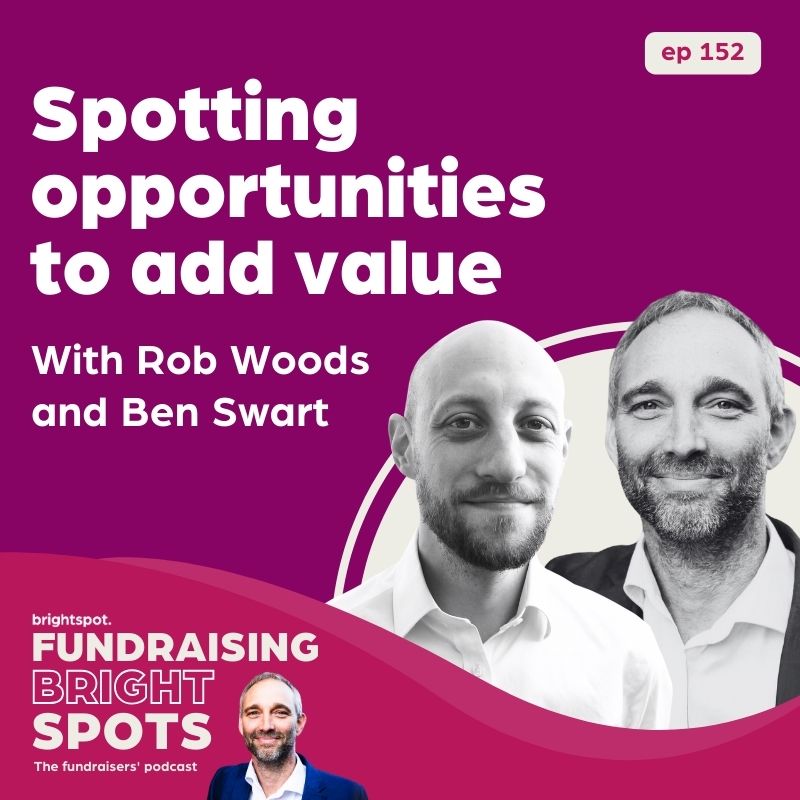
To help you look again at opportunities (that might be under your nose), Rob and Ben share stories of creative, determined fundraisers doing things a bit differently and creating WOW moments for their donors / supporters. The episode also features a special appearance from a brilliant fundraiser named Naomi, who shares the extraordinary story of how she discovered the difference her thank you call made to one of her charities’ supporters.
We’d love to know what you think! And thank you for supporting our show, for instance by sharing it with colleagues or on social media. We are both on LinkedIn and on X / Twitter Ben is @benswart and Rob is @woods_rob.
Episode overview
[01:24] Ben shares some of the common challenges faced by fundraisers, and Rob suggests solutions based on successful examples.
[03:41] Rob shares examples from corporate and major gifts mastery programmes, emphasising the power of being creative and resourceful. In particular an example of a fundraiser harnessing an opportunity to organise a unique donor appreciation event, focusing on making donors feel good.
[11:44] Ben and Rob discuss a fundraiser’s innovative Christmas card approach and its impact on donor engagement.
[15:58] In design terms, when you look at your thank you cards and Christmas cards, do they bring WOW? (Or do they fit into the expected script?) Rob and Ben share the importance of being resourceful and creative in fundraising, using available resources effectively.
[18:02] If you’re worried about making phone calls, you’re not alone. Ben discusses fundraisers’ fear of making phone calls and its impact on results, seeking strategies to overcome it.
[19:21] Fundraiser Naomi shares the positive impact of making thank you calls, making people feel appreciated, as well as increased engagement.
[21:34] Ben and Rob discuss the impact of personal stories in understanding donors’ perspectives and the significance of making donors feel valued. They share an example of a fundraiser’s persistence in reaching out to a supporter and the resulting successful donation.
[24:46] They dive into the psychological benefits of giving and how crucial it is, as a fundraiser, to remember that giving feels good! You are offering people the chance to do something amazing, so why wouldn’t you feel confident and proactive in inviting people to meet you / come to your event / donate to a cause they care about? Focusing on this helps you be more confident and resourceful in building great relationships with supporters.
[28:19] Rob and Ben discuss the influence of mindset and focus on fundraising outcomes, emphasising the need to question subjective interpretations – eg ‘Are they really ignoring you? Or is it actually much more likely that they were simply too busy to reply to your email?!’
Stay in touch
To join our mailing list / get access to our newsletter, including to hear about our popular Breakfast Club for Fundraising Leaders, which happens every 3 months, follow this link.
Want to transform your Corporate Partnerships or Major Donor fundraising?
To learn tried and tested techniques for growing corporate partnerships income, and get help in implementing them, check out our ever popular Corporate Partnerships Mastery Programme.
Or to grow your skills, confidence and RESULTS in Major Donor or Trusts fundraising, check out our flagship Major Gifts Mastery Programme, now in its tenth year.
Want to go deeper and get 24/7 access to LOTS more inspiring training?
Our training and inspiration club for fundraisers, the Bright Spot Members Club, has an extensive library of Rob’s best training films, a supportive community, and access to live masterclasses and problem-solving sessions with Rob and other experienced fundraising / leadership trainers EVERY WEEK. To find out more about how to get access to all these resources, go to here.
———-
Transcript of Episode 152
Ben Swart (00:00:00) – ‘People out there worry quite a lot around. ‘Am I interrupting someone? Am I annoying them? Am I a nuisance?’ And I’ve noticed for lots of people it’s a worry that could be affecting their results.’
Rob Woods (00:00:16) – ‘She sent those ten out to those top donors and again, the amount of lovely feedback she got was just different. And happily, she did it because it would make them feel good’.
Naomi (00:00:29) – ‘He just said, I’ve never, ever been contacted by any charity that I’ve supported before, just to be thanked, and it really put a smile on my face and made my day. So then, yeah, when I got back to the office again, I realised he’d given another donation off the back of our chat.’
Rob Woods (00:00:48) – Hey there, brave fundraisers. This is Rob Woods, and this is episode 152 of the Fundraising Bright Spots podcast. This is the show for anyone who works in fundraising, wants ideas, and maybe a dose of inspiration to help you raise more money and really enjoy your job. First up, thank you ever so much to all you fabulous people who’ve been posting so generously on LinkedIn and on Twitter about this podcast and how much it’s helping you and our recent Breakfast Club and the various other resources that we’ve been sharing.
Rob Woods (00:01:24) – I do always appreciate your help so that more and more people can get access to this free content. This time we’re doing a slightly different show. I’m going to be joined by my good friend Ben Swart. Hello, Ben.
Ben Swart (00:01:36) – Hello, Rob. Lovely to be here.
Rob Woods (00:01:38) – How are you?
Ben Swart (00:01:39) – I’m very good.
Rob Woods (00:01:41) – You have been out and about doing all these training sessions for individual charities recently, as well as your work, going more in depth to help charities with corporate partnerships at a next level. And you were there helping out at our Wow Your Donors the other day. And as ever, the luxury of how many fundraisers you get to work with regularly means you’ve got your ear to the ground of really a strong sense of what’s going well, but also inevitably, what some of the challenges are that are making fundraising hard?
Ben Swart (00:02:12) – And, Rob, I thought we could do this slightly differently to your normal podcasts because I’ve noticed whenever we catch up what we think is going to be a five minute conversation, I start sharing some of these problems that a person from a small, medium or large charity has told me, and you can’t help yourself but come up with some amazing ideas and solutions based on the people that you’ve worked with, the mastery programmes.
Ben Swart (00:02:37) – And then we have this lovely chat. So what I would quite like to do is to share some of those challenges. The most common things that I hear fundraisers, fundraising leaders and anyone say. And then just like we do that, I’d love you to start telling me some of the things you’ve noticed that can help. Can we do that?
Rob Woods (00:02:54) – Yeah, I would love to do that because every time I teach or I interview people on the podcast, I do get new good ideas, especially from the front line of the kinds of things that brave, creative fundraisers are doing. And those very examples often serve me to reframe and think of the possible rather than the impossible., and so if I can, I’m going to share some of those examples, especially from our corporate mastery and our current major gifts mastery programmes. They are approaching the end now. We’ve just done day three the other day. So we’ve got day four coming up soon. And it’s such a joy for me to hear back on days two, day three, day four about how people are getting on and how things are becoming easier.
Rob Woods (00:03:41) – Progress is happening. So if I can share some of the things those people have been doing with our listeners, and if it could just help give our listeners a boost today, then that would be a great result, I think.
Ben Swart (00:03:55) – Brilliant. Well, I was just talking today to somebody who is the head of a team, and one of the things that she’s noticed that they’ve really struggled with, and there’s I think two aspects to this is one of them is many of the donors, institutions, trusts and companies that she and her team are trying to get coffees and conversations in with. And if you’re playing Rob woods bingo test drives,, but more test drives that I know is a core part of the mastery course., one of the challenges that they’re finding is that the donor seems like the signals they’re sending are we don’t want you to have conversations with us, or we don’t want unsolicited approaches. I think that is the phrase that she used. And that coupled with, I think some things they’re noticing across the board with cost of living crisis, with communications that are having internally and externally, that just seems to be an almost, I think, an exhaustion of what should I do, Rob? How do I feel like I’m getting a sense of progress? What are ideas that I’ve got? And I’m interested, I, I’ve noticed really early on on the mastery courses, there’s some things that you do and some stories you’ve heard that have helped shift this and, and flip it on its head.
Ben Swart (00:05:05) – What would you say?
Rob Woods (00:05:06) – There’s a couple of things that occur to me. One of them is quite short and sweet, and it’s kind of obvious in a way. But there’s a brilliant fundraiser called Rachel who was on our last Major Gifts Mastery programme. But I spoke to her about ten days ago, and she just shared with me this example of coming back from, I guess, day two of our programme. And she was thinking, what can we do to help our wonderful supporters, generous supporters of all kinds? How can we get closer to them, help them feel thanked? I don’t want to like… they’re being so generous. I don’t want to go out and seek more money as much as just make them feel great, which is one of the objectives of our Wow Your Donors work. And she heard that in a couple of months time, there was going to be a series of events on the lawn outside the hospice,, and other departments than hers in the hospice were hiring a marquee for these events.
Rob Woods (00:06:06) – Nothing to do with fundraising, but she chatted with the person organising the events, and it turned out that at least one, if not two of the days during that week it was up. The marquee wasn’t going to be used. So she put two and two together and said, I wonder if I could do an extra thanking event? That’s never happened before and no one’s asked me to do it. No donors have said. Please, could you make us feel special? I wonder if I could do that anyway. She just got that idea in her head. She had the conversations needed. Didn’t cost the charity any more for the venue. Beautiful marquee already up and so on. Forgive me. I don’t know the details of whether they were able to get some refreshments sponsored or whether they did require a little budget for that, but then she and her colleagues sent out letter sender emails, made phone calls. They managed to get 130 of their charity supporters coming to this lovely, warm, happy, thanking event, making their Community Supporters Trust’s major donors, companies, volunteers, making everybody feel really good.
Rob Woods (00:07:13) – She was very specific. I mean, you don’t need to do this, but she was very clear to all of her colleagues not to ask for money. The outcome was to make these generous people in her community feel great, as she worked hard on the details. She got lots of photos sent in by the different supporters. So there’s photos of people doing this classic car event and there’s, you know, various other fun runs and Tough Mudders and skydivers and different like, and they had a constantly running photo loop of all the different wonderful people doing different things to help this hospice do what it does. Again, they didn’t ask for money. I think they did tell a couple of lovely welcome speeches, probably including a couple of stories about the kinds of difference that is made because these generous supporters do what they do. Oh, and also she worked hard to introduce different groups to each other. You know, that really important emotion of connection, connecting this kind of supporter to that kind of supporter. And by all accounts, everyone appreciated it.
Rob Woods (00:08:16) – There was so much goodwill and though they didn’t ask for money, there were some donations. And guess how much easier it was for Rachel and her colleagues to get follow up conversations with any of those groups. Set up 1 to 1 visits to the hospice following that event, when people had got re-inspired by the difference their generosity had already made, and also just this wonderful feeling of belonging and feeling part of something bigger than just themselves.
Ben Swart (00:08:49) – I love that Rob. I’ve noticed one of the challenges is some people might think that that’s the sort of event that they’re inviting somebody to, but without realising it, their focus on the invitation and the focus on the event is still what can I get out of them? Can I explain to them that we need money? Can I help them see we fit their criteria, whereas there is just a difference in the way you speak, the invitation, the agenda of the day. If the aim is, what can I do to help them feel good about this interaction? Like that’s that just shifts my whole focus away from what can I do to prove we fit your criteria, that we should be there for a solicited gift? I love that, I know it sounds like a tiny thing, and I can imagine the listeners like I don’t.
Ben Swart (00:09:36) – I can see why it might not seem so different, but imagine your focus if it were only on what could I do to help this person feel good about being associated with us?
Rob Woods (00:09:47) – Yeah, that’s a really good point. I have to say, I shared that example at a virtual conference I was speaking at yesterday, and someone was saying, you know, how on earth did she get 130 people to come? I got a fraction of that when I did something similar. And I honestly think a massive upside to what you just said the focus was on give, not get. The outcome was on making people feel great rather than sort of a bait and switch. Get them to come and then see if we can also ask because she and all her team were super clear that was the outcome. I think that would have come across in your voice when you’re on the phone. Yeah, asking someone to come and it would affect the courage of Rachel’s team member picking up the phone or sending a follow up text or email.
Rob Woods (00:10:34) – If you know you’re genuinely seeking to give, not get, I think you get braver and more congruent and more likely to persevere. And that, I think, is part of the reason why 130 people came.
Ben Swart (00:10:48) – Yeah, I love it. In your time doing the Masters. Rob, have you got another answer to that? Yeah. Challenge that you’re thinking of.
Rob Woods (00:10:54) – And it fits the same category really. It’s another example from our mastery program, which finished a few months ago with an excellent fundraiser called Emily And. She liked our concept of wow, your donors, as in do something just a bit different or better than what people would have expected. So if the listener could picture what Christmas card, if at all they did or didn’t send to their supporters last December, I bet there’s some really good ones. Emily decided she wanted to make her decent Christmas card. Just have a bit more story to it, a bit more. Wow. And she didn’t know what to do. But then she was searching around for an idea.
Rob Woods (00:11:44) – And then she remembered that every year for her children’s hospice, one of her colleagues organises a visit by someone who’s got these animals, different animals, different years for the children to meet and pet and so on. And it’s just a lovely event. Anyway, Emily remembered this and she talked to her colleague, I guess in marketing or the person who organised the event and found this beautiful photograph of this very cute little penguin on someone’s lap. You can’t see the child’s face, but you can see the cute penguin is being stroked and adored. And so they used that to create this Christmas card. They kind of Christmas-ified it with some kind of sparkly snowflake design around and completely different kinds of Christmas cards. And they’d sent out before Emily and her colleague sent all of those out, and they just got such a level of warmth and engagement back from people just loving it. And she thought, well, I’m not going to stop there. I’ve got, I don’t know, eight, nine, ten, especially generous donors, kind of really those who have donated most or most stretch for them in the last year.
Rob Woods (00:12:54) – Could I just build on this? And what she did was she got a tiny bit of budget and she worked with, I think it was Etsy or similar company, and she got these little wooden penguin sort of Christmas decorations. Or you could hang it up, you know, for different reasons depending on faith. She sent those ten out to those top donors. And again, the amount of lovely feedback she got was just different. And happily, she did it because it would make them feel good. It was also interesting to note, said Emily, that within a week or two, she received a new donation from one of the people who she’d sent a penguin Christmas tree decoration to.
Ben Swart (00:13:32) – I love this Rob. I was in the room, I think, when you shared this example, at Wow Your Donors event. And one of the steps I love that you shared was clearly we don’t all have penguins, but actually and I’ve done this since with a room of fundraisers. If I look at our current thank you cards, if I look at our current Christmas cards, if I look at the current way that I am choosing to thank a donor, is it the same way we’ve always done it? A bland way that I thought was quite powerful at the time, but if I paused for a second and just looked at it and thought it through, who am I sending it to? And really, does this genuinely get across who we are and the impact we make and the feeling we give the people we help, or what it was like on that day? Have I seen any other photo that does that? Have I noticed anything on the website, in social media? Anywhere? Actually, I have to tell you, having done this in a room two days after wow your donors with a room of another charity, it took seconds for people to say, oh no, my current cards are nowhere near as good as the three photos I’ve seen recently on Twitter.
Ben Swart (00:14:36) – Are you saying we should just grab those? I love that it’s not the penguins. That’s the point. It’s the choice to decide to look for it. Find it? Yeah. Get them mocked up and then and then do it. Which is quite an important distinction. Yeah.
Rob Woods (00:14:54) – And I think the reason I put both those examples, Rachel making use of the Marquise and Emily making use of the penguins, what they both have in common is both resources were under their nose all along and they could easily have missed it. And dear Lister, many of your colleagues may be likely to miss it, especially if they get seduced by the much publicised challenges going on in the world today and for charities today. Be it cost of living or donor fatigue, it is understandable that we focus our attention sometimes on all the reasons why fundraising is hard right now, which is not for me to say those things aren’t factors right now that affect the fundraising environment. But the problem is, if you focus too much of your attention on them, I think you are less likely to do what Emily and Rachel did and be resourceful.
Rob Woods (00:15:58) – And as Ben is saying, look around you notice some things, even if it’s not a penguin. Is there some resource, some assets, some key? Some story, some photo, some prop, some marquee. Is there something actually that might well be available that actually with a little courage in and creativity and a conversation with a colleague you could think through, maybe we could do this thing to actually increase our chances of really making our supporters feel special, or really increasing the chances that people would want to take a call with us, or have a coffee with us, or come to our event, i.e. what’s under your nose. Yeah. Hi, it’s Rob, and I wanted to let you know about our two long standing training programs designed to help you grow high value fundraising results. That’s Major Gifts Mastery and Corporate Partnerships Mastery, which both start again in April 2024. These programs help you make progress through a combination of master classes and individual coaching support, to give you a sense of how they help you improve not only your skills, but also your confidence and your results.
Here’s some feedback we had from Grace Cannings who took part in Major Gifts Mastery.
Grace Cannings (00:17:12) – I think going back to being kind of more confident, I’d say that it’s helped me become more calm in meetings with donors. And I know I think it was maybe a couple of weeks after our first session, I was in a meeting with a donor and managed to secure a 25 K gift from them, which was incredible. And it was the first meeting I had actually run by myself without anybody else from my team being there. So it felt like a really big win for me. And then also alongside that, we’ve had more people renewing their donations and gifts. And I think just generally the level of communication that I’ve been able to give with people has been great. Yeah. I just implore anybody to go on this course. It’s been fantastic.
Rob Woods (00:17:52) – If you’d like to find out more about either of these two programs, go to brightspotfundraising.co.uk/services.
Ben Swart (00:18:02) – You know, the other thing I hear a lot, especially when I’m talking to fundraisers about confidence picking up the phone, is people out there worry quite a lot around.
Am I interrupting someone? Am I annoying them? Am I a nuisance even if I’m calling to thank them? Ben, I you know, Rob, you talk a lot about ‘a thons’. I remember my colleague who told me the one grumpy story of the person who didn’t like getting the phone call. And I’ve noticed for lots of people, that’s not just a worry. They say in the training room with me or on the Or when talking to me. Actually, it’s a worry that could be affecting their results, and I know we’ve noticed some different things. Last time I talked to you about this, it took me a very long time to stop you talking. So I’m intrigued because I love these. I love some of the answers to this. What is it that you’ve noticed on mastery courses and beyond that that can help a fundraiser with that? Worry about the phone.
Rob Woods (00:19:03) – Okay, here’s the one that occurs to me, and it is quite recent. About a month ago, we were on day three of Major Gifts Mastery, and we were talking about interesting things that happened and things we were pleased with.
And there’s a very smart fundraiser called Naomi, and she shared this thing that happened.
Naomi (00:19:21) – We tried this idea for Thankathon just before Christmas. So it was really led by our individual giving manager. I work more interesting foundations, but it was a whole team effort. We’re quite a small team, so we divvied up a list of people that we wanted to phone simply to thank before Christmas, and got our board members involved, and it was a really positive experience, a really fun exercise, actually. And just to enjoy people’s surprise that your full name, simply to thank you, could definitely notice the tone in their voice changing as you as we spoke and said no, I really am feeling just to thank and not to ask. So it was. It was a lovely experience, but I got on a plane to come over to the Bright Spot fundraising course that I’m doing, and I sat beside this gentleman and we started chatting. What are you heading to London for?, I said, well, I work for a charity.
Naomi (00:20:13) – I’m actually heading over for some training. And I got chatting and he was like, oh, what’s, what’s the charity that you work for? And there was just this moment where both of us clocked that we had spoken to each other on the phone during the phone calls before Christmas. So his accent stood out to me. He wasn’t from Northern Ireland, he was from Scotland. And there was just this moment of no way. And he was like, I got your phone call just before Christmas. I was actually in London at the time. I was having a really busy day. I saw the missed call. I thought he was trying to pester me. And then when you phoned again, I thought, oh, I’m going to have to answer this. And he was like, I’m so glad I did because it literally made my day that you were filming just to say thank you., and then he just said, I’ve never, ever been contacted by any charity that I’ve supported before, just to be thanked.
Naomi (00:21:04) – And it really put a smile on my face and made my day. So we couldn’t believe how small a world it is that we ended up sitting beside each other on a flight. Then yeah. When I got back to the office again, I realised he’d given another donation off the back of our chat. So not saying that everyone you phone randomly like that will end up sitting beside you on a plane, but it was a lovely example just of how much it meant to him, and hopefully to the many others that we were able to contact. I would recommend it.
Ben Swart (00:21:34) – I love that story. Not just because of that lovely collision and coincidence, but because that’s the sort of story that would help me before I was about to pick up the phone, to just feel what it’s like on the other side, that that is the opposite of being a nuisance, right? Even if initially he’s like, why is this charity calling me? Because he’s got a frame of what he thinks it’s like.
Ben Swart (00:21:55) – I love that he was so happy. That is not someone just being polite on a flight. That is someone truly saying, this has changed me. Do you know what, Rob? When I do this in a room, I’ve noticed it sparks one story, might not do it, but then a second and a third suddenly sparks people realising, oh, I’ve got lots of other examples of where people who we’ve interrupted and talked to to say thank you or about our organisation or they’re giving, they’ve said, why are you thanking me? I think you’ve got more, haven’t you?
Rob Woods (00:22:23) – There’s another one from day two of the current mastery program. And the gist of the story is that someone had, first of all, worked really hard to get through on the phone to a supporter. And for various reasons, it just hadn’t worked out. But she didn’t give up and feel all that. They’re ignoring me or they hate me, or I feel like she just persevered. She tried different days, different times and so on.
Rob Woods (00:22:49) – In the end, she did manage to get through and arrange for an existing supporter to come on a visit to the charity. And then it fell through. But again, she just said it all up again. In spite of that being a bit of a challenge, they did that second visit. The people who made use of the charity services weren’t there on the day, but she introduced the donor to one of her colleagues and heard some amazing stories about the difference the charity makes, and was able to just have a good chat about what’s so difficult for the particular community that that service serves. Anyway, near the end, the donor said, you know, I would like to do more. It’s clearly such important work. Long story short, they ended up agreeing to a new donation. I think it was £12,000, which was more than twice as much as they had ever given before. But the thing that the fundraiser particularly fed back to our group was he then said, I didn’t tell you this at the start because I didn’t want to fuss.
Rob Woods (00:23:50) – But today is my birthday and honestly, this is the best birthday present I could possibly have. Being able with these resources, I’ve got to know that I’m making this much difference to keep these particular people more safe from danger. Thank you for making my birthday and both these stories to go together for me. If ever I’m nervous about picking up the phone or wherever, I think, oh, should I ask? Giving is good for people. Adam Grant, the psychologist, has done various studies showing it releases wonderful feel good hormones, dopamine and endorphins and all the rest of it in our blood. If and when someone gets the chance to look beyond themselves and do a kind or generous act, they feel amazing. Probably our listeners know this feeling like maybe it didn’t happen today, but at some point in the last week or two weeks, you did a kind thing listener, and maybe you did it because you’re a good person. You did it out of duty or did it. You felt you had no option.
Rob Woods (00:24:46) – But in that moment, it felt good. The challenge in fundraising is sometimes we forget this because our colleagues talk about, please, can you go and get us some money? Like how we need more funds to pay for the thing? We think about philanthropy in terms of the difference it makes to the charity and in particular to those it serves. Sometimes we forget it’s a wonderful, generous thing. If you can arrange for someone like that supporter to get to be even more generous to the tune of £12,000, and hopefully this conversation, this story might just remind you to see that side and in that moment be that bit more brave. I mean, not in a pushy way, in a relaxed, calm way, knowing that you’re doing a generous thing to offer them a coffee, a visit, or even the chance to donate.
Ben Swart (00:25:38) – I love that, Rob. As ever, when you tell a real story like that, suddenly my brain is thinking of all the examples I’ve got that are similar. If you let me.
Ben Swart (00:25:47) – There’s two very quick ones. One is I haven’t just been a fundraiser for many years. For the last year I have sat on a foundation, the Asos Foundation, and having raised so much money for so long, I loved that feeling. I thought there was no feeling better after our first trustee meeting. Board meeting? Where we signed off £1 million worth of giving. Calm down. Fundraisers who were listening? When we signed off £1 million worth of giving. I’d never felt like that before. I had never felt like that. Knowing that four organisations were now going to do the things that they put into the proposals, and we met one of them. It was extraordinary, a totally different feeling, which chimes with exactly what you just said. I remember taking a donor on a visit to Childline on the 5th of January, and she said she was a high powered lawyer, accountant. She said at the end of this visit, it was the first day back in the year of the year for her.
Ben Swart (00:26:40) – She decided to put it in the diary, so before she’d even got into the office, she went on this visit of Childline and as she was walking out, she turned around to me and said, this is the best beginning to a year I have ever had been. I would normally be in a room talking about tax and legislation. I don’t know how I’m going to replicate this feeling, and at the time I thought I’d never forget that. But you know what? Before the next week, when I went to pick up the phone as an inexperienced fundraiser, I don’t think I focused on those feelings. Whereas one of my favourite things about the mastery, I was talking to someone recently who their coach helped them to remember. They felt like they were being ghosted by a particular prospect, you know, like they weren’t getting back to them, they weren’t replying to emails, and their coach asked them about when was the last time you actually had a conversation with them, not the things that are going through your head about why they’re not replying and they don’t want to give or they don’t like us.
Ben Swart (00:27:31) – When was the last time you had a conversation with them? And she said, oh, it was about three months ago. What happened? How did they leave that? They said they loved our work and they wanted me to get back in touch, but they’d be really busy. And you just suddenly has state changed. And it gave her the confidence to get back in touch. And lo and behold, a few weeks later there was a gift. I love that even though we know these, these ideas or these experiences are in our head somewhere, you do need some help deliberately finding them to change your state before you’re about to do something scary, like pick up the phone or me meet someone. I love that Rob, because without me stacking these memories and ideas and examples, yeah, my state and belief in my ability on the phone or the need for it would be quite low too.
Rob Woods (00:28:19) – Yeah, really great examples. Ben. There’s a couple of things that occur to me. One is I was listening to the diary of a CEO podcast recently, and he was talking to, I think, a former CIA operative or expert who Paris training really had to better understand the human brain and human nature in order to do what he does.
Rob Woods (00:28:41) – And he was making a very powerful point about, in that impactful training, learning the difference between subjective and objective ideas. Said differently, the human mind for all human beings comes up with lots of stuff. The risk is that many human beings believe that everything their mind gives them is true, and they’re just too accepting. Or if I think that way, then that’s the truth. Whereas a lot of the power of that training is helping, you see, there’s the subjective thing. The mind can be correct, the human brain can be correct, but equally, it just is prone to emotionality and focusing on the most recent thing that happened, whereas one gets sceptical about it, one questions it, and one’s much more likely, therefore, to be objective and see the truth and act on the truth of what’s really going on here, rather than what the mind offered up as meaning and linked to. That is the truth, that how you feel in any given moment will make a huge difference on what you’re willing to do as a fundraiser.
Rob Woods (00:29:50) – What affects how we feel? Well, one of the things is what you focus on, and I love your story there, because maybe the last three pieces of evidence, the lack of answer to my email. If you focus on those, you will get an erroneous subjective computation. They hate us. We’re bothering them. I should stop if you change your focus and ask the question, do I have any evidence of when giving is great for people? They’re happy to hear from us. People love our charity. This particular supporter has said they do really care if you change for a better question and therefore focus on those pieces of evidence, it does shift how you feel and therefore your ability to bravely, confidently pick up the phone, send the email, go and talk to your colleague in finance, whatever it was that you’d been putting off because you were believing this understandable but actually inaccurate interpretation of the data, then we need to finish soon. I hope our ideas and examples have just given some encouragement or inspiration or nudge to our listeners.
Rob Woods (00:30:57) – I’m really conscious that not every charity has much training budget to be found, so their main way of learning is these free resources like the podcast and The Breakfast Club and so on. Did I do that? If our listener has some kind of sense that not just hearing a short example on a podcast, but really coming into our world for six months masterclass, go away, go back to your job. So coaching, if a combination of these courses I do and all of the other support we give you would add up to a bigger difference in not only your skill and confidence, but also the results that flow from those two things. If you sense it would really help you. There are still a few places left at the time of publishing this podcast on both the Major Gifts Mastery programme and the Corporate Partnerships Mastery Programme that are due to start in mid-April 2024. So do check out our website brightspotfundraising.co.uk/services for information about those if it suits you. As always, we’ll put a transcript of this episode in the show notes in the podcast section of our website as well.
Rob Woods (00:32:05) – So do follow that, if you ever get a chance to share these episodes with your colleagues or your team, we’re always ever so grateful. But for now, thank you so much, Ben, for taking time to be the interviewer and share your examples, and especially to you, the listener. Thank you for supporting our show. Thank you for caring about listening and good luck with your fundraising. Bye bye.